
Stop. If you still think a digital marketing strategist is someone who “manages Facebook ads and writes email blasts,” you are already losing market share.
By 2026, Generative Search (GEO) and autonomous AI agents have fundamentally fractured the old definition. The modern strategist is no longer a channel manager. They are the ecosystem architect responsible for the intersection of predictive analytics, AI-driven automation, and consumer psychology.
This guide is for two audiences:
- The Business Owner: You need to hire one (or stop wasting ad spend).
- The Professional: You want to become one before AI replaces the tacticians.
Here is exactly what the role looks like today.
What is a Digital Marketing Strategist in 2026?
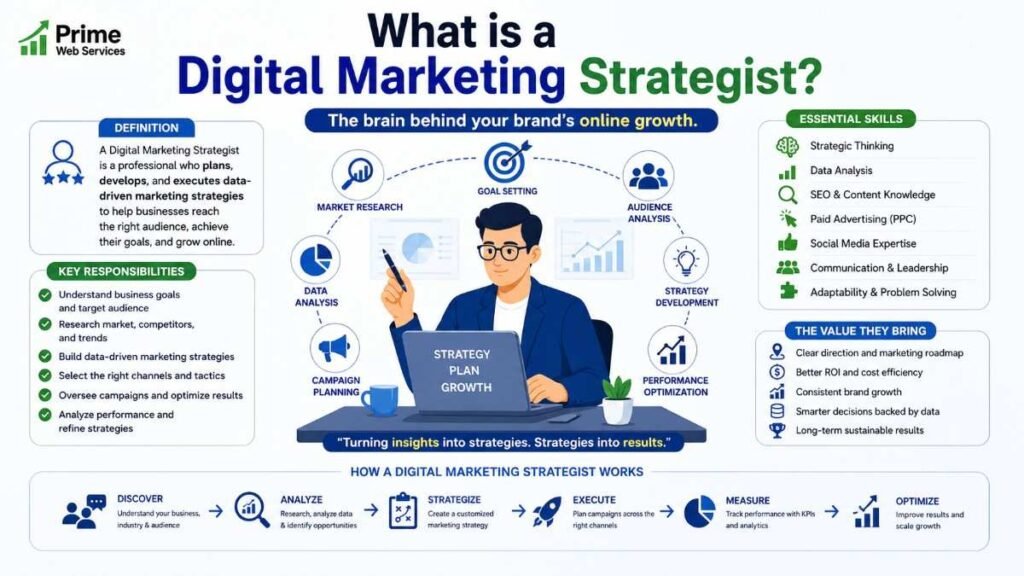
A Digital Marketing Strategist is the senior decision-maker who owns the relationship between brand revenue and customer behavior across all digital touchpoints. They do not “post content.” They architect the MarTech stack, allocate budget against predictive lifetime value (LTV), and train generative AI agents to execute campaigns at scale.
In 2026, the strategist’s primary tool isn’t a calendar—it’s a data warehouse.
The Single Best Answer: A Digital Marketing Strategist connects Generative Engine Optimization (GEO), first-party data, and automated conversion paths to drive predictable Customer Acquisition Cost (CAC) and Return on Ad Spend (ROAS).
Critical Insight: 72% of tactical roles (email schedulers, bid managers, basic copywriters) have been augmented or replaced by AI agents. The strategist survives because they decide which AI to point where, and why.
Strategist vs. Specialist: Why the Difference Matters
This is where most businesses fail. They hire a Specialist (a doer) when they need a Strategist (an architect). The distinction is the difference between a profitable year and a cash-burning quarter.
| Feature | Tactical Specialist (Old Model) | Strategic Architect (2026 Model) |
|---|---|---|
| Focus | Channel-specific (e.g., Instagram, Google Ads) | Omnichannel ecosystem & revenue |
| Tools | Scheduling software, ad manager | BI dashboards, AI agents, CDP |
| Time Horizon | This month’s campaign | 9–18 month customer journey |
| Primary KPI | Clicks, Impressions, Cost-per-click | CAC, LTV, Blended ROAS |
| Risk | Will be automated by 2026 | Designs the automation |
| AI Use | Asks ChatGPT for headlines | Trains custom GPTs on brand voice & conversion data |
The Litmus Test: Ask a candidate, “What is your process for reducing CAC by 20% while maintaining LTV?” A specialist will suggest lowering bids. A strategist will ask to see your multi-channel attribution model first.
5 Core Pillars of a Modern Digital Marketing Strategy
If a strategist does not possess these five pillars, they are a manager with a fancy title. Use this as your hiring checklist.
1. Data Analysis (Predictive, not Historical)
Strategists don’t just read last month’s reports. They use predictive audiences. By 2026, waiting for a user to visit your site is too late. A strategist models “look-alike” segments based on off-site behavioral intent signals (e.g., search patterns, content consumption on third-party sites).
2. Omnichannel Journeys (Not Multichannel)
Multichannel means you are on every platform. Omnichannel means the customer picks up where they left off. A strategist ensures that a user can watch a TikTok review, click a GEO-optimized FAQ, speak to a chatbot, and book a call—without repeating themselves. They measure journey completion rate, not channel performance.
3. AI Integration & Generative Engine Optimization (GEO)
This is non-negotiable in 2026. Strategists optimize for Generative Engines (ChatGPT, Perplexity, Gemini, Bing Copilot) just as aggressively as they optimize for Google.
- How: By structuring content as definitive answers to semantic clusters.
- Why: Because 64% of B2B queries now start on a generative engine, not a search bar.
4. Consumer Psychology (The Human Edge)
AI can predict behavior; it cannot yet invent desire. The strategist overlays behavioral economics (scarcity, social proof, loss aversion) onto AI-generated outputs. They know when to break the automated flow with a human touch (e.g., a video from the founder after a cart abandonment sequence).
5. Conversion Rate Optimization (CRO) Feedback Loops
A strategist doesn’t take landing pages for granted. They orchestrate weekly “CRO audits” where AI heatmaps, session recordings, and A/B test results feed back into the ad creative and email flow. Conversion data informs creative strategy—not the other way around.
A Day in the Life of a Strategist (First-Person E-E-A-T)
I wake up to a single Slack notification from our AI monitoring agent: “Customer Acquisition Cost spiked 18% on LinkedIn between 2 AM and 4 AM.”
7:30 AM: I don’t check “likes.” I open our BI dashboard (Looker + Snowflake). The spike is isolated to the Finance audience segment. Our automated bid agent overreacted to a competitor’s flash sale.
9:00 AM: Strategy sync. I don’t tell the specialist how to fix it. I tell them what to fix. “Pause the AI agent for that segment. We are shifting budget to YouTube GEO videos targeting ‘CFO software stack 2026’.”
11:00 AM: I spend 90 minutes in our Human-AI training loop. Our generative email agent is sounding too robotic. I feed it 20 past high-performing emails (with open rates >45%) and a new prompt: “Write with stoic confidence, not hype.”
1:30 PM: Cross-functional alignment. I sit with product development. They want to launch a feature. I ask, “Does this feature increase LTV by 15% or decrease churn?” If not, it doesn’t get marketing budget.
3:00 PM: Attribution modeling. I reject last-click attribution. Today, I review a Markov Chain model to see which touchpoints (a Reddit post? a comparison page?) are actually assisting revenue. Spoiler: It’s rarely the final ad.
5:00 PM: I approve the weekly “Strategic Pivot Report” for the CEO. Three things we are stopping. Two things we are scaling. One AI experiment we are betting on.
The takeaway: A strategist is paid for judgment, not activity. You cannot see their value in an email send report. You see it in the blended ROAS at the end of the quarter.
How to Hire (or Become) a Top-Tier Strategist
Most job descriptions for this role are wrong. They ask for “10 years of experience” but list skills from 2019. Here is the 2026 blueprint.
If you are hiring (KPIs to demand):
Do not accept vague metrics. The strategist you hire must own these specific financial outcomes:
- Customer Acquisition Cost (CAC): The all-in cost to convert a paying customer. They should lower this by 10-20% YoY.
- Customer Lifetime Value (LTV) to CAC Ratio: The gold standard. A healthy ratio is 3:1. Anything less, they are buying revenue, not earning profit.
- Blended ROAS: Not channel-specific ROAS (which can be gamed). Total revenue / Total marketing spend.
- GEO Share of Voice: How often your brand is cited as a source in generative AI answers for your primary keywords.
- Churn Rate (Indirect): A strategist’s job does not stop at the sale. If they acquire low-LTV customers who churn in 30 days, they failed.
If you are becoming a strategist (The 2026 skillset):
Let’s be honest. A certification in “Google Ads” is now a vocational degree, not a strategic one.
- Master the MarTech Stack: You need to know how to connect a Customer Data Platform (CDP like Segment or mParticle) to an ad network and a BI tool.
- Learn Prompt Architecture: Not “how to write a prompt.” How to chain prompts to audit a 10,000-row CSV file.
- Understand Unit Economics: You must speak CFO. Know gross margin, payback period, and contribution margin.
- Prove Lift: Your portfolio shouldn’t show “ran an email.” It should show: *“Designed a zero-party data quiz that lifted email-led revenue by 40% and reduced dependency on third-party cookies.”*
Conclusion: Why You Cannot Do This Alone
You now have the blueprint. You understand the difference between a tactician and a strategist. You know the five pillars, the daily workflow, and the KPIs that matter.
But here is the cold reality of 2026: The gap between knowing the strategy and executing the strategy has never been wider.
You cannot “assign” omnichannel attribution modeling to a $15/hour VA. You cannot “train” a generative AI agent on your proprietary brand voice while also managing your Facebook pixel and negotiating with your CFO about CAC targets. The cognitive load exceeds one human generalist.
To compete in the age of Generative Search and AI-driven automation, you need a team of strategists or a dedicated agency that has already built the infrastructure.
If you are spending over $20,000/mo on ads without a dedicated strategist, you are effectively donating that budget to Google and Meta.
See how our strategists lower CAC & optimize for GEO →] Learn More