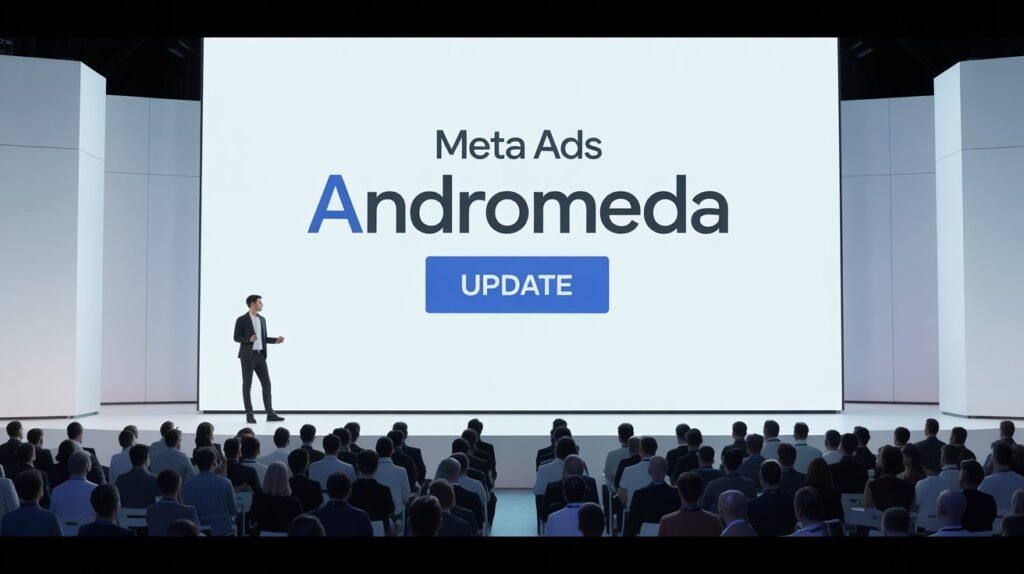
Meta Andromeda Update 2025 is reshaping how Facebook and Instagram ads work, from how campaigns are structured to how creatives are delivered. If your ads suddenly stopped performing the way they used to, you’re not alone.
The Andromeda system fundamentally changes how Meta’s algorithm retrieves and ranks ads. Instead of relying on hyper-specific targeting or dozens of ad sets, it now rewards broad targeting, strong creative diversity, and data accuracy.
In this guide, we’ll break down exactly what the Meta Andromeda Update is, what changed under the hood, and how you can rebuild your campaign structure to align with this new system, ensuring your ads continue to perform in 2025 and beyond.
What Is Meta Andromeda?
The Andromeda Update is Meta’s next-generation ad-retrieval engine, the part of the platform responsible for deciding which ads are shown to which users.
Previously, Facebook advertisers could win by creating many small ad sets targeting narrow interest groups. Andromeda changes that. It uses advanced machine learning models and custom Meta AI chips to scan through millions of ads in real time and automatically match users with the best creative for them.
In short:
➡️ The algorithm, not your manual targeting, decides who sees your ad.
➡️ Your creative (video, image, text, tone) is now your most powerful targeting tool.
➡️ Broad audiences and clean data signals perform better than ever.
Why Meta Introduced the Andromeda Update
Meta’s ad ecosystem had reached a breaking point. Over the years, advertisers created thousands of micro-audiences and ad sets, each with small budgets and limited data. This made it harder for Meta’s AI to learn and optimise effectively.
Andromeda was designed to solve that problem by:
- Processing far more ad candidates simultaneously.
- Reducing dependency on manually defined interests.
- Focusing optimization on creative performance and conversion signals instead of audience filters.
- Delivering better ad relevance for users while improving results for advertisers.
In short, Meta wants advertisers to stop over-segmenting and start feeding the algorithm larger data pools with more creative options.
How the Andromeda Update Affects Advertisers
Here’s what’s changed most visibly since the rollout:
1. Broad Targeting Now Outperforms Narrow Targeting
Previously, you could get great results by stacking interests and behaviors. Now, that approach limits performance. The algorithm prefers broad targeting, letting it find the right people automatically based on signals from your ads and conversion data.
Example:
Instead of targeting “men aged 25-40 interested in fitness and supplements,” you can target “All adults in India” and let Meta decide who is most likely to buy your product.
2. Creative Diversity Becomes the New Advantage
With Andromeda, the ad creative is your new targeting. The system looks at how different creatives perform across audiences and automatically matches each creative to the right type of user.
This means:
- You need 8–15 distinct creatives per ad set.
- Variations must be meaningfully different, not just changing a background color or headline.
- Include different hooks, styles, and formats: reels, carousel, testimonials, UGC videos, and image ads.
- Creatives that perform best get distributed automatically to the audiences most likely to convert.
3. Simpler Campaign Structure Works Better
Gone are the days of 20 ad sets with separate budgets.
The new best practice is one campaign per objective, one broad ad set, and multiple creatives.
This allows the algorithm to:
- Learn faster.
- Optimize budget automatically.
- Reduce overlap between ad sets.
- Deliver higher overall efficiency.
4. Signals and Tracking Matter More Than Ever
Andromeda relies on high-quality conversion data to decide which users to show your ads to.
To stay competitive:
- Make sure your Meta Pixel and Conversions API (CAPI) are properly installed.
- Track key events like add-to-cart, purchase, and lead submissions.
- Avoid duplicate or missing events.
- Pass value data (like purchase amount) to improve optimization.
If your signals are weak, the system simply doesn’t know who’s a good customer, and your results will drop.
Recommended Facebook Campaign Structure for 2025
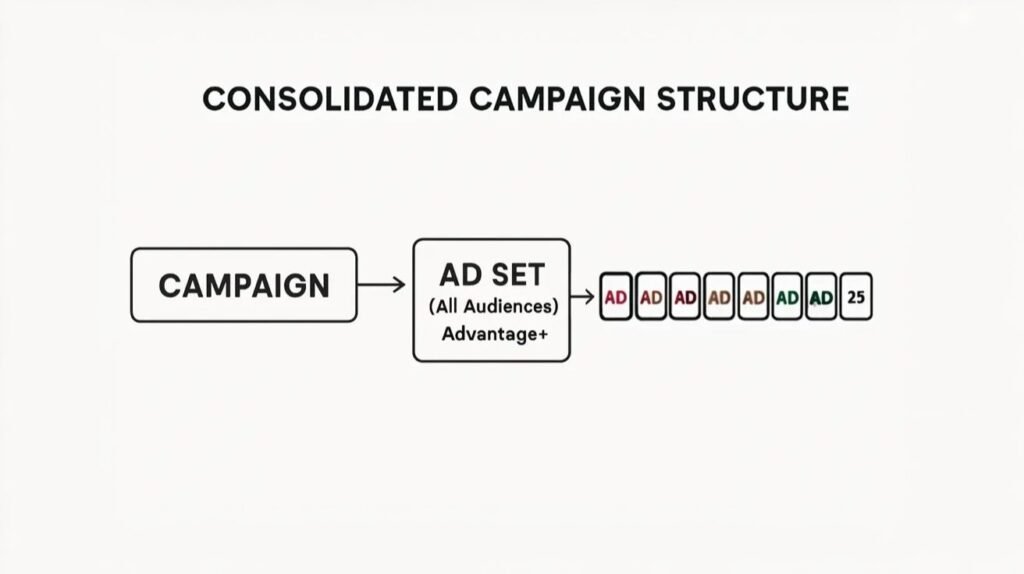
Here’s a simple, battle-tested campaign setup that aligns with the Andromeda system.
Step 1 – Choose One Clear Objective
Select a single campaign goal — for example:
- Sales (website purchases)
- Leads (form submissions)
- Traffic (landing page views)
Avoid mixing objectives in one campaign. Keep the signal clean and focused.
Step 2 – Campaign Settings
- Turn on Campaign Budget Optimization (CBO), Meta will automatically distribute budget to the best-performing creatives.
- Use Advantage+ Placements to let the system test across all surfaces (Facebook, Instagram, Reels, Audience Network).
Step 3 – Ad Set Setup
- Audience: Broad targeting (entire country, age 18-65+, all genders).
- Optimization event: Purchase or Lead.
- Exclusions: Add custom audiences for existing customers if needed.
- Budget: Start with a healthy daily budget (₹1,000–₹3,000 minimum) to collect enough data.
Step 4 – Ad Creatives
- Add 8 to 15 unique creatives.
- Each should have a unique concept, not minor edits of one ad.
- Use different styles:
- Lifestyle video
- Product demo
- Testimonial clip
- Carousel with benefits
- Short Reels-style vertical video
Focus on storytelling, emotional hooks, and clear calls-to-action.
Step 5 – Launch and Learn
Let your campaign run for at least 5–7 days without major changes. The system needs time to learn and stabilize performance.
Monitor key metrics:
- ROAS (Return on Ad Spend)
- CAC (Customer Acquisition Cost)
- MER (Marketing Efficiency Ratio)
Avoid judging performance too early, patience pays off in the Andromeda era.
Creative Tips for Better Results After the Update
Here’s how top advertisers are succeeding with the new system:
- Use storytelling over sales pitches
Ads that educate or entertain before selling tend to perform better. - Include social proof
Testimonials, user videos, or influencer collaborations give Meta stronger positive engagement signals. - Optimize for sound-off environments
Many users scroll silently, use captions and on-screen text. - Refresh your creatives every 2 weeks
The retrieval engine penalizes repetitive creatives. Keep introducing new hooks regularly. - Mix video and static formats
Video drives discovery, while carousels and images often seal conversions. Balance both.
Common Mistakes to Avoid
- Running too many ad sets: Splitting your budget weakens learning and increases costs.
- Reusing the same creative with minor edits: Meta’s AI detects “similar ads” and limits their reach.
- Turning off campaigns too soon: Allow the algorithm a learning window before optimizing.
- Ignoring Pixel errors: Even a small signal mismatch can derail optimization.
- Testing audiences instead of creatives: In 2025, creative testing is far more valuable than audience testing.
Before vs After the Andromeda Update
| Aspect | Old Facebook Ads Strategy | New (Andromeda) Strategy |
|---|---|---|
| Audience Targeting | Narrow, interest-based | Broad, algorithmic |
| Campaign Structure | Multiple small ad sets | Single broad ad set |
| Creative Focus | 3–5 simple variations | 8–15 diverse creatives |
| Optimization | Manual | Fully automated |
| Key Lever | Targeting | Creative + Signal Quality |
FAQs: Meta Andromeda Update 2025
1. What is the Meta Andromeda Update?
It’s Meta’s rebuilt ad-retrieval system that uses AI to match ads with users more accurately. It replaces heavy manual targeting with automated, creative-driven optimization.
2. How should I structure my campaigns now?
Use one campaign per objective, one broad ad set, and 8-15 distinct creatives. Turn on Campaign Budget Optimization and automatic placements.
3. Why did my Facebook ads stop working recently?
If your ads rely on narrow targeting, too few creatives, or old campaigns, Andromeda’s new engine likely can’t learn enough from your data. Simplify structure and refresh creatives.
4. Does detailed targeting still matter?
Not much. The algorithm now identifies potential buyers automatically. Focus on creative diversity and conversion tracking instead of micro-audiences.
5. How long should I let campaigns run before optimizing?
Wait at least 5–7 days to allow the learning phase to complete. Frequent changes reset the learning process and hurt performance.
Conclusion: Embrace the New Meta Ads System
The Meta Andromeda Update 2025 marks a turning point for Facebook advertisers. The old rulebook, filled with detailed interest stacks, multiple ad sets, and manual tweaks, no longer works.
To thrive now, focus on:
✅ Broad targeting
✅ Strong creative variety
✅ Reliable tracking signals
✅ Patience during the learning phase
Advertisers who adapt early to this new structure are already seeing better results — lower costs, higher reach, and improved ROAS. Those who resist will find their campaigns gradually losing traction.